
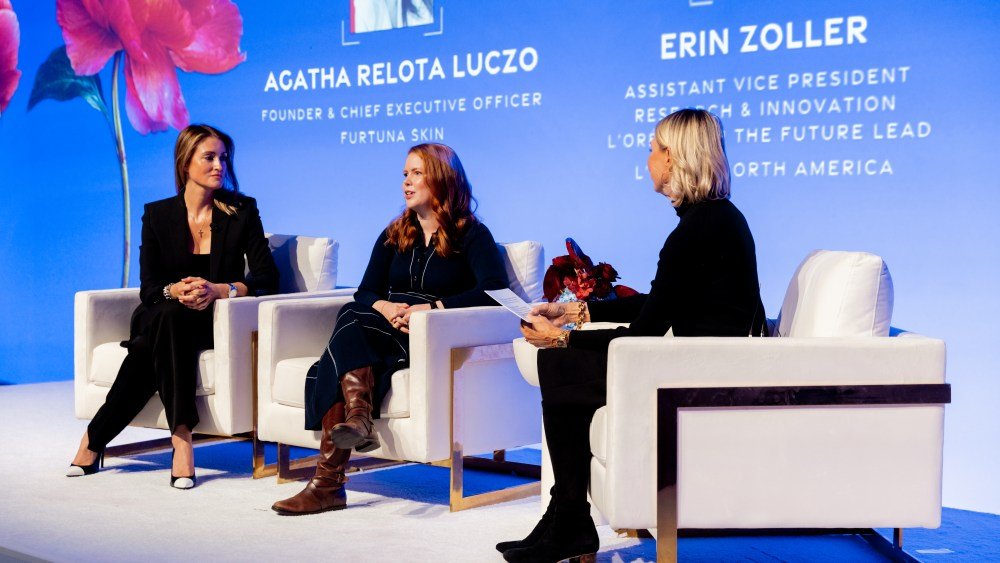
When Agatha Relota Luczo’s husband was 10 years old, he made a promise to his grandmother that he would bring Sicilian land back into the family.
“That’s what we did,” said Relota Luczo, founder and chief executive officer of Furtuna Skin. “We acquired 750 acres of this beautiful land. It feels like it has a heartbeat and wants to give. All 750 acres are certified organic. We practice regenerative farming. Seventy percent of this land is part of one of the most important bio preserves in the European community.”
The farm is run by Furtuna’s chief scientific officer, Dr. Pasquale M. Marino, who has discovered more than 500 wild species of plants on the farm, 80 of which are medicinal.
“I started in the world of modeling, and worked with many different beauty experts — makeup artists, dermatologists and skin experts — to define what the skin needs. I’m also an olive oil sommelier, and Furtuna Skin is where those two worlds meet. It’s the power of the olive and the wild botanicals meeting advanced skin care technology.”
Relota Luczo was speaking alongside Erin Zoller, assistant vice president of Research & Innovation and L’Oréal for the Future Lead at L’Oréal North America, in a conversation moderated by Pamela Gill Alabaster, adjunct professor at Columbia University and board director and adviser, at Beauty Inc Catalysts. As part of the beauty giant’s green sciences program, Zoller works within research and innovation to bring together biotechnology, sustainable cultivation, green chemistry and green extraction to help scientists explore new ways to create high-performing ingredients and formulas.
“Within our portfolio, we’ve already made huge strides in terms of transformation. As of the end of 2025, 67 percent of ingredients in our formulas were from nature or recycled materials, and we have the ambition to go further,” Zoller said. “We’re looking to move beyond 75 percent by the end of 2030. And of course, every single development we do, we need to ensure that it’s safe, there’s quality, it’s efficacious. I see sustainability as an additional dimension that we use in order to really develop and evaluate our innovations.”
At L’Oréal, biodiversity is considered at the very start of the product development process, even before a scientist enters the lab. “As we’re looking at ingredient selection, where those ingredients are sourced and produced, we see in beauty that so many ingredients are coming from more of a deep understanding of nature rather than harvesting more from nature,” Zoller explained. She gave the example of biotechnology, where scientists look at microorganisms to harness their power in order to create mini production centers. That way, they can create molecules through fermentation in a controlled environment.
Relota Luczo then talked about how she hired a botanist before any other position. “Dr. Pasquale was with the farm before Furtuna Skin was even launched, and one of his first goals was to build this herbarium. He walked the land, documenting all 500 different wild species on the farm, 32 distinct plant communities, which cannot be replicated.…We use this herbarium as the beginning of all of our formula innovation. Our land is not just our raw supplier, but it is our innovation partner.”
As for L’Oréal, in terms of using biotechnology to replace a cultivated or wild botanical, it never automatically assumes it’s going to be the best solution, Zoller noted. “We know that biotechnology can reduce pressure on some more traditional ingredients. But we also know that fermentation itself takes water, energy and feedstocks. So that’s why it’s so important that we’re evaluating every single innovation on its own merits and looking at the environmental footprint as well as the other trade-offs.”
Alabaster concluded that “nature is more than a source for ingredients, and when we embrace nature as an innovation partner, we can learn from her ingenuity, and also protect our ecosystems that inspire us.”